Inhaltsverzeichnis
Swiss Army receivers
 In the early days of radio communications, receivers produced by Telefunken, Berlin were mainly procured for the Swiss Armed Forces. With the advent of World War II, more Swiss-made equipment was introduced, such as superhet receivers from Autophon and Zellweger.
Surveillance receivers were acquired in larger numbers, and high-quality communications receivers were purchased in small numbers for interception services and radio surveillance.
Nomenclature
In the early days, receivers were designated by an abbreviation Exx, E standing for receiver and the number for the year of introduction.
In 1951, a new nomenclature was introduced in the Swiss Army. Receivers were henceforth given the designation E-6xx, and the devices were numbered consecutively according to chronological order. The receivers still in service received a new designation according to the E-6xx nomenclature in addition to the old one.
Receivers of the Swiss Army
| E-600 (E39) | 1939/41 | Single conversion | 100 kHz - 60 MHz | coil sets for frequency ranges |  |
| E-601 (E41) | 1941 | Single / double conversion superhet | 100 kHz - 60 MHz | Coil sets for frequency ranges |  |
| E-602 (E44) | 1945/51 | Single conversion | 100 kHz - 37 MHz | drum tuner, separate mains power supply with output stage / loudspeaker |  |
| E-603 (E45) | 1945/51 | Single conversion | 3 - 15 MHz | turret tuner, separate mains power supply; Air Force alert message receiver | 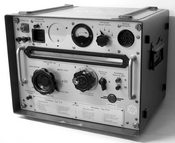 |
| E-604 (E46) | 1942/5 | Single conversion | 27 - 101 MHz | VHF surveillance receiver | 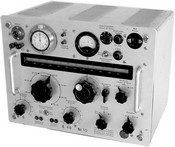 |
| E-606 | 1965 | Single conversion | LW, MW, SW, UKW | Portable radio with HF-TR |  |
| E-627 | 1952/56 | Single conversion | 1,5 - 32 MHz | Military AM receiver | 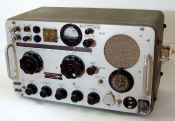 |
| E-628 | 1955/58 | Single conversion | 20 - 180 MHz | Military VHF receiver | 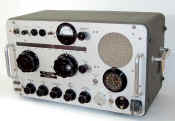 |
| E-646 | 1980 | Single conversion | 2 - 12 MHz | Receiver for air alert message system |  |